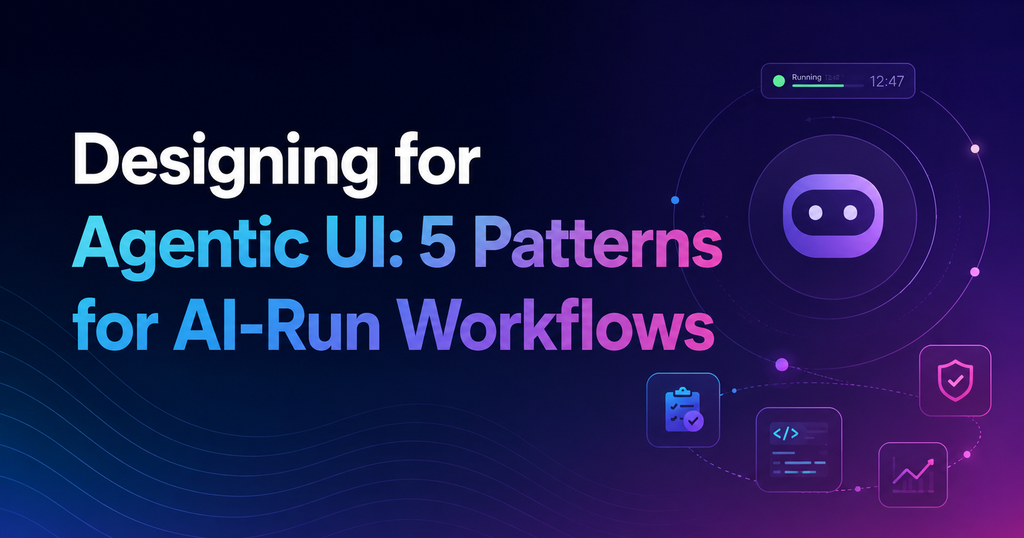
TL;DR — AI agents in 2026 run for minutes or hours, not seconds. That breaks every UX assumption built for synchronous tools. Here are five patterns product teams are shipping to design for long-running AI workflows — status surfaces, trust checkpoints, and interruption handling.
Why agentic UI is different
A synchronous AI returns in under a second and gets dismissed. An agentic AI may be running 30 minutes after you close the tab. The user has to trust that it’s still working, know what it’s doing, and be able to interrupt it — none of which chat UI does well.
The 5 patterns
1. Persistent status surface
A panel, not a chat log. Shows current step, elapsed time, overall progress, and a cancel button. Visible across sessions — closing the tab doesn’t hide it when you return.
2. Checkpoint confirmation for high-stakes actions
Before the agent does something irreversible (send an email, make a payment, push to production), it pauses and shows a diff or preview. User confirms or corrects. Autonomous until it hits a boundary.
3. Live thinking view
A streaming view of the agent’s reasoning — condensed, not verbose. Enough to build trust, not so much that it overwhelms. Claude’s and ChatGPT’s reasoning-streaming UIs are good references.
4. Interrupt + redirect
A user can interrupt at any time with “actually, do X instead” and the agent picks up from the new instruction without losing context. Much harder than it sounds — requires careful state management on the agent side.
5. Post-run summary with sources
When the agent finishes, a summary of what changed, what was touched, and what decisions were made. Clickable back to any artifact. This is also where failures get surfaced — not during the run, but summarized at the end.
What’s still unsolved
Agentic UX is new enough that several problems don’t have mature patterns yet:
- Multi-agent orchestration (how do you visualize 3 agents cooperating?).
- Long-running task resumption across devices.
- Cost visibility — making the dollar/compute cost of an agent run legible.
- Delegation consent — when and how a user authorizes an agent to act without asking.
Frequently asked questions
Should I show all the agent’s reasoning to the user?
No. Stream a condensed version — enough to build trust, not so much that it overwhelms. Let power users expand to see raw reasoning if they want.
How do I handle agent failures gracefully?
Stop the run at the failure, summarize what was done before the failure, and give the user three options: retry, edit-and-retry, or cancel. Never silently give up.
What’s the minimum viable agent UI?
Status indicator (running/done/failed), elapsed time, and a cancel button. Everything else is polish.
Found this useful? Read Micro-Interactions in 2026: The New Rules of Motion UX for the companion guide on how motion reshaped product design this year.