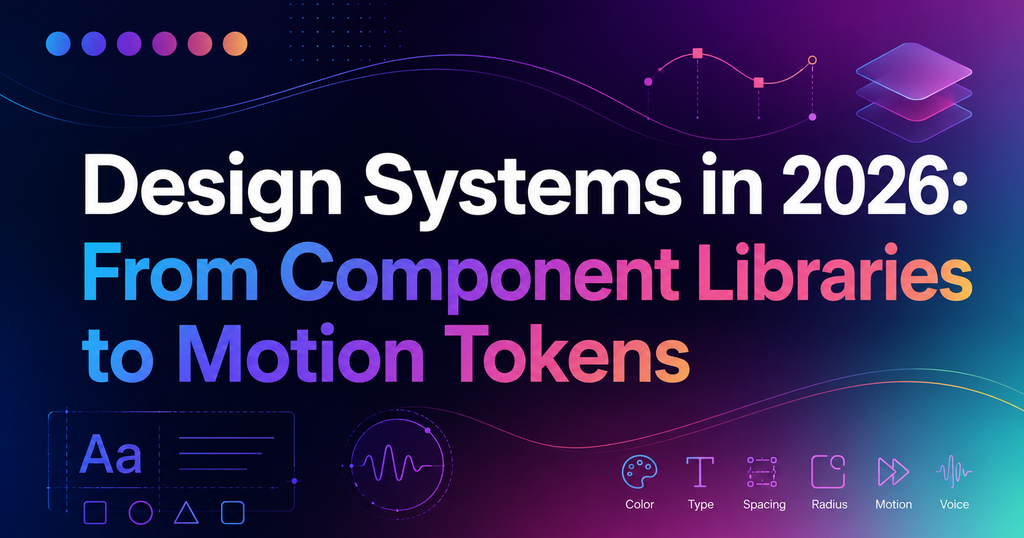
TL;DR — Design systems in 2026 are larger in scope and smaller in ceremony than in 2020. Motion tokens, voice guidelines, and AI-generation rules now sit alongside color and type. Governance is lightweight — a team of 2-3, not 12. Here’s the architecture working in production this year and how to bring yours up to it.
What a 2026 design system covers
The surface area has grown. A modern system tracks:
- Tokens — color, type, spacing, radius, elevation, motion, voice.
- Components — including accessibility and motion specs per component.
- Patterns — multi-component compositions for common tasks.
- Content guidelines — voice, tone, copy patterns, AI-content rules.
- Accessibility rules — WCAG 3 Silver as the floor for component inclusion.
Three architectural shifts that matter
Tokens are the contract
Five years ago, the component library was the contract. In 2026, it’s tokens. Components are replaceable implementations of a tokenized system. Teams can fork components for platform reasons, as long as they consume the same tokens.
Motion is tokenized
Named durations, named easings, named springs. Components consume them. A branch consistency issue that previously required a human review is now enforced by build-time token checks.
Docs are generated, not hand-maintained
Stories, usage examples, prop tables, accessibility callouts — all generated from the source. Documentation drift has finally stopped being the dominant failure mode.
Governance that actually works
- Small core team (2-4 people). They own tokens, accessibility review, and release cadence.
- Federated contributions. Product teams contribute components, the core team reviews for consistency.
- Contribution ladder. New component → candidate component → stable. Clear bar for each stage.
- Deprecation policy. Every deprecation ships with a codemod and a six-month window.
- Public changelog + quarterly demo. Treat the system as a product with users (internal teams), not infrastructure.
What to do this quarter
If your system isn’t at the 2026 bar yet, the highest-leverage work in order:
- Get motion into tokens. Even four tokens (tap, modal, page, toast) is a huge jump.
- Add WCAG 3 Silver as the inclusion bar for any new component.
- Kill hand-maintained docs. Generate from source.
- Write the voice guidelines down. Not as a slide — as a versioned document.
- Add a contribution ladder so product teams can add components without bottlenecking on the core team.
Frequently asked questions
Should a small company have a design system?
Yes, but scoped. Three tokens, five components, two patterns is still a system. The trap is trying to build Material Design before you have ten screens.
Tailwind or a custom system in 2026?
Tailwind has matured into a reasonable utility base; pair it with your own tokens for brand consistency. Pure Tailwind without a tokenized brand layer is still a trap for medium-sized teams.
How do I measure design system success?
Adoption (% of product surface using system components), consistency score (cross-product audits), and velocity (time from new design to shipped component). Avoid vanity metrics like “component count.”
Found this useful? Read Micro-Interactions in 2026: The New Rules of Motion UX for the companion guide on how motion reshaped product design this year.